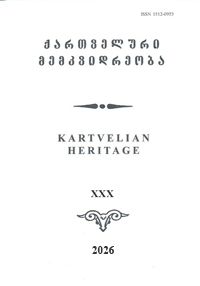
Phraseological Units in the Tao Dialect
DOI:
https://doi.org/10.52340/PUTK.2026.30.11Keywords:
Georgian dialectology, Tao dialect, dialect vocabulary, phraseological unitsAbstract
Over the centuries, the strong influence of Turkish in historical Tao has gradually weakened the position of the Georgian language, pointing to an ongoing process of assimilation. Turkish operates as the official language of communication in Tao, functioning as the state language of the Republic of Turkey across institutional and public spheres, while Georgian is largely restricted to intra-familial and domestic contexts, where it frequently encounters competition from Turkish. Despite this unequal bilingual environment, the speech of Georgians living in the highland villages of Tao (Khevai, Kvabai, Balkhi) has to some extent preserved essential features of the Georgian language. In this regard, the vocabulary is of particular interest.
The research draws upon dialectal texts (audio and video materials) recorded in situ from local Georgian speakers during dialectological expeditions conducted between 2006 and 2025 in Tao, particularly in the Georgian villages of the Parkhlistskali Valley. The Tao data have been compared with materials from the Georgian literary language and other Georgian dialects, and the resulting correspondences and divergences have been presented.
The figurative phraseological units, proverbs, admonitory sayings, and fixed expressions attested in the Tao dialect are predominantly common Georgian in origin; they are also found in the Georgian literary language and in other dialects. Certain units, however, display structural or semantic variation in Tao usage. Some of the phraseological units appear to be specific to Tao speech, either as authentically dialectal constructions or contact-induced developments shaped by Turkish linguistic influence.
The analyzed lexical material is important for the study of the language, history, and culture of the Georgians of Tao. It reflects important aspects of the linguistic and ethnic identity of Tao’s indigenous Georgian population, along with Tao’s historical developments and contemporary socio-cultural dynamics. The presence of Turkish influence is observable in certain expressions, where Georgian words have been replaced by Turkish forms. Such constructions reflect the current linguistic situation in Tao and show the ongoing process of Georgian-Turkish linguistic and cultural interference.
References
Neiman 1978: Neiman A., Dictionary of Georgian Synonyms. 3rd edition: Tbilisi, Publishing House "Education", 1978.
Orbeliani 1991: Orbeliani S.-S., Georgian Dictionary. Tbilisi, Publishing House "Merani", 1991.
Oniani 1966: Oniani A., Georgian Idioms. Publishing House "Nakaduli", Tbilisi, 1966. http://openlibrary.ge/bitstream/123456789/9100/1/Kartuli%20idiomebi-oniani.pdf Verification:: 10.02.2026.
Sakhokia 1979: Sakhokia T., Georgian figurative words and expressions. Tbilisi, Publishing House “Merani”, 1979.
Paghava.. 2020: Paghava M., Tsintsadze M., Baramidze M., Chokharadze M., Shioshvili Sh., Khalvashi R., Mgeladze N., Shashikadze Z., Khalvashi M., Chkhvimiani J., Karalidze J., Tao (monograph). Publishing House "Meridiani", Batumi, 2020.
Paghava.. 2024: Paghava M., Tsintsadze M., Baramidze M., Taoist Dialect of the Georgian Language (Research, Materials, Dictionary). Publishing House "Meridiani", Batumi, 2024.
Putkaradze 1993: Putkaradze Sh., Georgian of Our Own, Book I. Publishing House "Adjara", Batumi, 1993.
Database of Georgian Idioms and Proverbs Funds https://idioms.tsu.ge/?cat=18 Verification: 14.02.2026.
Georgian Dialect Corpus (http://www.corpora.co/#/corpus). Verification: 14.02.2026.
Explanatory Dictionary of the Georgian Language (https://ena.ge/explanatory-online). Verification: 14.02.2026.
Exped. Material: Dialect material recorded in Tao by the author of the article in 2008-2025. Stored in the Prof. Tariel Putkaradze Scientific-Research Center of Kartvelology at the Faculty of Humanities of the Georgian State University.
Downloads
Published
Issue
Section
License
Under The License Attribution 4.0 International CC BY 4.0 Deed , the authors retain all rights. The authors grant a publisher the exclusive right to publish the work for the first time, but they do not assign ownership.