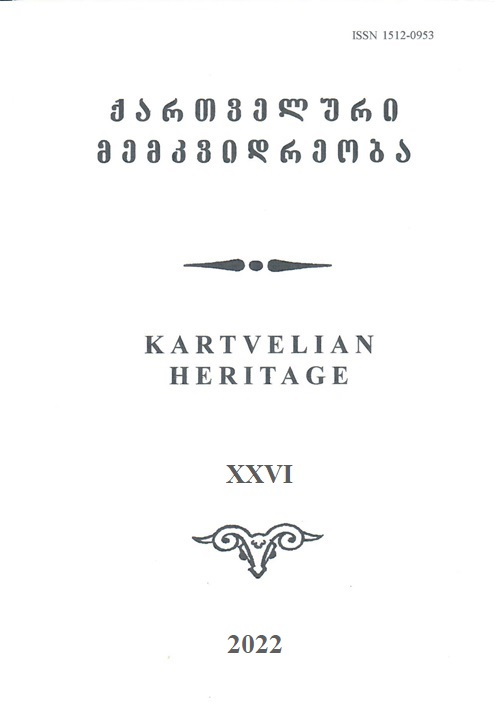
ON CONJUGATION OF VERBAL FORMS WITH AUXILIARIES IN THE SPEECH OF GEORGIANS OF TAO
DOI:
https://doi.org/10.52340/PUTK.2022.26.04Keywords:
Georgian language, Taoian dialect, verb formationAbstract
The Conjugation of verbal forms with auxiliaries was not a characteristic of the archaic literary Georgian. The relevant examples have begun to occur in Georgian literary monuments since the 10th-11th centuries. The descriptive patterns are widely spread in dialects, compared to the literary language.The proposed article offers an analysis of the material recorded by us in the villages of Tao (Turkey) in the course of the dialectological expedition of 2011-2022. For comparison, we have also employed the published texts of the Taoian dialect (Sh. Putkaradze, 1993; M. Paghava, 2020). In Taoian dialect, there are the occurences of descriptive forms of transitive verbs in Present Indicative (vtḥri-vart - vtḥrit, we dig, vrċqi-vart , we water, svam-ḥar, you drink), which indicate the tendency toward uniformity; they seem to be formed in the nalogy of intransitive verbs (vt’iri-var (I cry), ic’ini-ḥar (you laugh) and so on). In Taoian dialect, the number of patterns of verbal forms with auxiliaries is relatively small, compared to the forms with organic formation. It should be considered that the contact between Georgian and Turkish, to some extent, contributed to the dissemination of patterns of verbal forms with auxiliaries in present in Taoian dialect (any types of verbs in present time in Turkish are verbal forms with auxiliaries). However, considering the dynamics of the emergence and development of verbal forms with auxiliaries in the Georgian literary language and the dialects, the current situation in Taoian seems to be the result of the functioning of inner rules of development within the dialect. The same situation is found in the Kartvelian dialects – Megrelian and Lower Svan. It can be claimed that the rule of forming verbal forms with auxiliaries in Taoan is similar to that of the Georgian literary language and the dialects, and it reflects the common Kartvelian way of verb formation.
Downloads
Published
Issue
Section
License
Under The License Attribution 4.0 International CC BY 4.0 Deed , the authors retain all rights. The authors grant a publisher the exclusive right to publish the work for the first time, but they do not assign ownership.